
Finance Minister Nirmala Sitharaman on Friday pitched for front loading of capital expenditure, saying it is critical for revitalisting the economy post the coronavirus pandemic. During a virtual meeting with senior government officials to discuss the infrastructure roadmap ahead, she also asked ministries to aim to achieve more than their capital expenditure (capex) targets. The Union Budget 2021-22 provided a capital outlay of Rs.5.54 lakh crore, a sharp increase of 34.5 per cent over the Budget Estimate of 2020-21.

The government would fall short of its target for direct tax collections for the second consecutive year, with the revenue department estimating its direct tax receipts at Rs 3,70,000 crore (Rs 3700 billion) for 2009-10.

Only 80.6 per cent of the Rs 6-trillion allocation has been spent by February, data from the Controller General of Accounts shows.

"Lot of misinformed speculation is going around in media. Government's fiscal math is completely on track. There is no proposal to ask RBI to transfer Rs 3.6 or 1 lakh crore, as speculated," Economic Affairs Secretary Subhash Chandra Garg tweeted.

As a percentage of the aggregate Budget expenditure, it is 12 per cent.

The government will borrow Rs 5.03 lakh crore in the second half of the current fiscal to fund the revenue gap for reviving the pandemic-hit economy, the finance ministry said on Monday. During the first half, the government has raised Rs 7.02 lakh crore by issuing bonds, the ministry said in a statement. "Out of gross market borrowing of Rs 12.05 lakh crore projected for FY 2021-22 in the Union Budget, Rs 7.24 lakh crore (60 per cent) was planned to be borrowed in first half (H1).

The government on Wednesday said it will borrow Rs 7.24 lakh crore in the first half of 2021-22 fiscal to meet resources to perk up the economy hit by the coronavirus pandemic. According to the Budget 2021-22, the government's gross borrowing was estimated at Rs 12.05 lakh crore in the financial year beginning April 1. "In the Budget, we had announced that there would be a gross borrowing of Rs 12.05 lakh crore and net borrowing of Rs 9.37 lakh crore. "In the first half of 2021-22, we would be borrowing Rs 7.24 lakh crore, which is 60.06 per cent of the gross issuances," economic affairs secretary Tarun Bajaj said. He said the government would issue 2-year, 5-year, 10-year, 14-year, 30-year, and 40-year securities.

India's rank in the World Bank's ease of doing business index cannot get better unless more attention is paid to bringing about procedural reforms in the way states run their governments and provide various approvals for trade and industry, says A K Bhattacharya.

This is slightly better than the fiscal deficit position last year when it was 85.6 per cent of the Budget target.

'Not disclosing information to the public indicates that there is something wrong with Project Cheetah.'
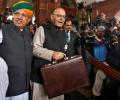
Pensioners, India Inc may get tax breaks in Budget
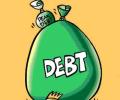
The total debt of the government increased by 6.7 per cent in the second quarter ended September 2013.

Do the actual numbers bear out the claims made by the government or do they suggest something else? asks A K Bhattacharya.

Revenue buoyancy of GST will be key to improve the resource position of both central and state governments.

Sliding for the fifth straight session, the rupee fell 3 paise to close at a fresh lifetime low of 79.06 against the US dollar on Thursday amid a strong greenback overseas and unrelenting foreign fund outflows. At the interbank forex market, the local unit opened at 78.92 against the greenback and witnessed an intra-day high of 78.90 and a low of 79.07. It finally settled at 79.06, down 3 paise over its previous close of 79.03.

As much as Rs 3.64 lakh crore has been collected as advance tax, which is 14.5 per cent higher than the advance tax collections during the same period last year.

'The rupee falling from 69 to 72 was not normal or justified by the fundamentals.' 'And therefore I treat this as temporary.'

A communiqu sent by the department of investment and public asset management (DIPAM) to the heads of all PSUs, said the move would help the government to get predictable and periodic dividends before Budget estimates are firmed up.
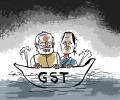
Rates may be raised from 5 per cent to 8 per cent and 12 per cent to 15 per cent. The Council can explore possibility of merger of slabs to bring down the number of slabs to three. The Central GST collection fell short of the Budget Estimate by nearly 40 per cent during the April-November period of 2019-20

Govt may tighten presumptive taxation norms and also do away with some deductions.

By taking the mutual fund route, investors can take exposure to gilts with small amounts. Over a decade or more, returns from these funds tend to be sound.
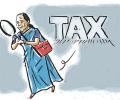
Providing comfort to the government on the revenue front amid fiscal stress, direct tax collection is moving closer to the revised Budget target for 2021-21 and may get a further thrust from the last instalment of the advance tax payment, the deadline for which ended on Monday. The contraction in net direct tax collection narrowed to 5 per cent year-on-year as on March 15 compared to a 9 per cent decline seen in January. In absolute terms, net collection stood at Rs 8.2 trillion against Rs 8.67 trillion in the same period last year, according to the provisional numbers shared by a government official.
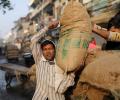
Growth rate in per capita income is projected to fall to the lowest in 21 years this financial year - except for the financial years 2019-20 (FY20) and 2020-21 (FY21) - according to the first advance estimates. During the last 21 years, the two periods - FY20 and FY21 - saw growth rates in per capita income lower than 7.9 per cent, seen during FY24. This was despite the real gross domestic product (GDP) being projected to grow by 7.3 per cent in the current financial year by the first advance estimates.

It is time to take a few macroeconomic risks to kick start the growth.

As India emerges from the COVID-19 crisis, the ninth budget under the Modi government, including an interim one, is widely expected to focus on boosting spending on job creation and rural development, generous allocations for development schemes, putting more money in the hands of the average taxpayer and easing rules to attract foreign investments.

Samajwadi Party chief Akhilesh Yadav said his party would oppose the Centre's move to bring a bill in Parliament to amend the 1995 law governing Waqf boards, and accused the BJP of trying to snatch the rights of Muslims.

The railways total earnings recorded an 8.3 per cent growth at Rs 33,900 crore (Rs 339 billion) up to December this year as compared to the corresponding period in the previous year.

On the basis of Budget projections, the Centre needs Rs 7.3 trillion revenue during December-March and its expenditure must be limited to Rs 6.7 trillion.

Even with the possible expenditure roll-overs and off-budget financing, the fiscal deficit target will not be met. The FRBM Act, after its amendment in 2018, allows a fiscal deficit slippage of not more than 0.5 per cent for any given year, provided there are justifications. These justifications include war, national security, severe collapse in the agriculture sector, a major natural calamity, big structural economic reforms, or the decline in real output growth of a quarter by at least 3 percentage points below its average of the previous four quarters.
After the RBI surprised the Centre with a record Rs 99,122 crore in surplus transfer for FY21, analysts said this will help the government tide over the revenue losses from lockdowns and extend more support to the pandemic hit industries and to the poor people. In fiscal 2020, the RBI had paid only Rs 57,128 crore in dividend to the government and the finance minister had budgeted only Rs 45,000 crore from the central bank. The higher payout followed the Bimal Jalan panel report that had set a new economic framework capital buffer for the central bank along with the contingency risk buffer at 5.5 per cent.

The highest collection target has been given to Mumbai at Rs 4.39 trillion, followed by Delhi and Bengaluru.
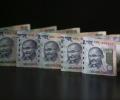
Govt squeezed capital expenditure, and also cut revenue expenditure, that does not go into creating assets, by 11% in H1

The capital outlay to cover the modernisation programmes have got a hike of 10.05 per cent.

Of the cash outgo, Rs 64,598 crore is for enhanced expenditure on fertiliser subsidy under Atmanirbhar Bharat Abhiyan 3.0 and Rs 20,466 crore for the capital outlay in defence services.

Reeling under a series of derailments, the Budget is likely to announce creation of a separate safety fund of about Rs 1 lakh crore over the next five years.
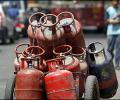
Govt targets 1 cr consumers to give up LPG subsidy.

As much as Rs 61,920 crore of tax refunds have been issued during April-July

The 2022-23 Budget has projected a disinvestment target of Rs 65,000 crore for next financial year. This is significantly lower than the estimated Rs 1.75 lakh crore budgeted for 2021-22. In the revised estimates, the target for 2021-22 has been cut to Rs 78,000 crore.

CBDT has been given a collection target of Rs 5.69 trillion in personal income tax in the fiscal year 2019-20 - 19.2 per cent more than the Rs 4.77-crore collection in the previous year.

Andhra Pradesh Chief Minister K Rosaiah on Saturday presented a tax-free budget for financial year 2010-11 with an outlay of Rs 1,13,675 crore (Rs 1.13 trillion) and a projected expenditure of Rs 1,13,660 crore.
 © 2026 Rediff.com - Advertise with us - Disclaimer - Privacy Policy - Sitemap - Feedback - About us - Terms of use - Grievances